
Fears

We all have fears, things that when we hear about them or see them, we shudder, we jump or we compartmentalize them and try to repress them. We all have at least one thing, if not more we're terrified of. And whatever fear or fears you have, there's not judgement here. Fears are something we all have, and depending on how common it is in our lives, we may have to deal with it often, sometimes or never. If you can think about your fear or fears right now, go for it. But please don't do this in a state where you're not ready to engage with something you're scared of.

Within this substack, I'm going to dissect how fears are formed and some ways within psychology to get over our fears. I'm going to cite information and leave a reference list at the bottom so you can read through the papers I use if you're interested to learn more about the topic. The stuff from papers will be paraphrased rather than quoted directly. Disclaimer, I'm a psychology student studying at university, not a licensed professional, please do not try any of the methods unless prescribed by a professional as this is just to educate and go deeper into our fears.
Firstly, what are fears? Within psychology, fears are defined by LeDoux (2017) as the feeling that conquers your mind when you're in crisis. An example of a fear is the dentist. The dentist is a classic fear a lot of people have, whether it's the sounds that scare them, the judgement of the dentist or the fear of the unknown of what's going to be said about their teeth and gums. That feeling of anxiety slowly takes over us, in whatever our fear is and it conquers our minds and thoughts. We ruminate over what's going to happen and think of the worst case scenarios, because in that state we aren't going to be thinking straight when we're too focused on the unknown.
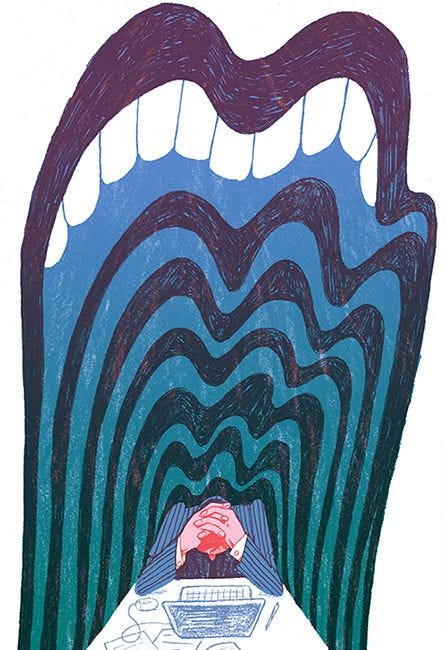
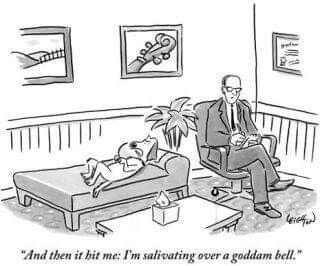
Now we know what fears are, how are they maintained? Fears are maintained through classical conditioning. Classical conditioning is defined (Rehman et al, 2017) as an unconscious procedure where an automated conditioned response associates with a specific stimuli. Taking the dentist example from earlier, this may mean when you hear a drill whilst sat in the waiting room, you may flinch. Or when you're sat in the dentist's chair and the dentist starts grabbing their tools for inspection, you may clench your hands on the arm rest of the chair. Classical conditioning can occur through past experiences, such as a bad experience at the dentist creating your fear of going there or rejection during your childhood creating the fear of being forever alone. A famous study, highlighting classical conditioning is Pavlov and his dogs.
Though I cannot find a paper to show you the study, this hyperlink from the office basically shows the gist of classical conditioning in an interesting way. Basically when the Microsoft reboot jingle goes off, Jim offers Dwight a mint. And soon enough, as shown in the video, Dwight soon starts to expect a reward each time the Microsoft reboot jingle goes off. When Jim doesn't offer Dwight the mint, Dwight's mouth starts to taste bad because he unconsciously associates the Microsoft reboot jingle with the reward of the mint.
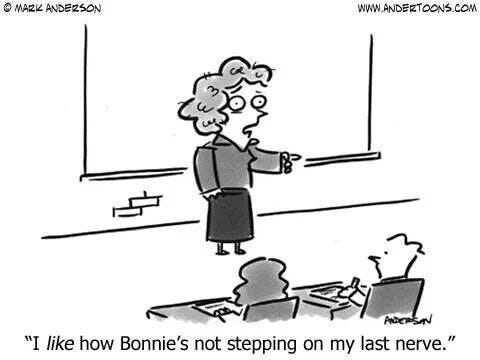
Now we know how fears are formed, and how classical conditioning works, we get to go onto how we maintain our fears. We maintain our fears through operant conditioning. Operant conditioning is defined by Kirsch et al (2004) as a type of learning that involves the acquisition of voluntary responses on its environment. This conditioning is characterised by reinforcement, positive and negative. Positive reinforcement is being rewarded for a specific behaviour, and a negative reinforcement is being punished for a specific behaviour. An example of this is from the Big Bang Theory. Sheldon gives Penny a chocolate every time she performs a desirable behaviour (E.G moving out of Sheldon's chair, taking the plates to the kitchen etc).
To connect this to fears, let's continue with the dentist fear we were talking about earlier. Our fear is reinforced as our anxiety before going to the dentist is really high as we're scared of what may happen and what the dentist may say. Now, if we decide to avoid going to the dentist and reschedule the appointment, avoiding going in that moment. We get the relief of not going to the dentist and our anxiety decreased. But the next time we go to the dentist at that rescheduled appointment, we're going to still have that anxiety and it may be worse then it was. The positive reinforcement was the relief we felt when we avoided the dentist as we voluntarily decided to reschedule the appointment. To give an example of negative reinforcement, let's say that we have a child. This child is called Robby Bobby (If you get that reference, thank you) and he keeps doing the 6-7 trend. Negative reinforcement would be doing the 6-7 trend back and burying the joke to make Robby Bobby cringe. This means that Robby Bobby would eventually stop doing the 6-7 trend and may find something else to do such as catch snakes or star in a music video with friends off a TV show.
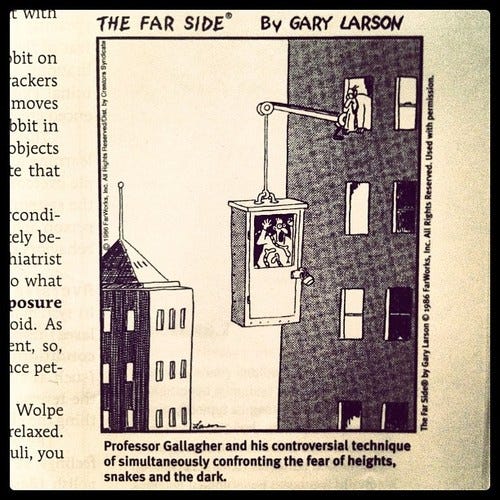
Finally, how are fears/phobias treated in psychology? There are multiple ways to treat them such as cognitive behavioural therapy. However, I'm going to introduce you to two ways you may not be familiar with: Fear Hierarchies and Flooding. We're going to be focusing on fear hierarchies first. Fear Hierarchies (Katerelos et al, 2008) start off by creating a hierarchy of your fear. So let's continue using the dentist example. At the lowest end, may be a photo of a dentist suite, and the peak point of the hierarchy may be sitting in the dentist chair getting a tooth removed and getting a filling done. You start off at the bottom and slowly build up to exposing yourself to the stages above till the peak of the hierarchy. You only move on when you're ready to and you're not scared of the step you're on. This is normally done with a therapist checking in weekly to see where you stand, but it can also be done by yourself. Within the cited paper, it focuses on social anxiety which is interesting to look into further and is something many of us experience (myself included).
Now onto flooding. Flooding as defined by Amanda et al (2024) is the process of putting someone into situations that create uncomfortable feelings such as fear which are imaginative or real. For instance, flooding for our fear of the dentist in an imaginary way, would be making someone to relax before getting them to imagine being in the dentist suite and sat in the dentist chair ready for a dental cleaning. Whilst, for the real scenario this would be done in reality. An obvious weakness of this technique is that you're causing someone harm by putting them through this and therefore breaking ethical guidelines as you're not protecting them from harm. This technique has mixed results, as though the cited paper showed reduced feelings in anxiety after partaking in the flooding, sometimes it can heighten the fear and only make things worse.
Before this article finishes, I'd like to address the limitations of these theories. Firstly a lot of the classical conditioning and operant conditioning comes from animal studies in the 60’s to the 90’s. Not only does this create ethical issues for the animals within the study as they are at harm, but as humans are such complex creatures, extrapolating the findings from animals to humans create issues within themselves. Extrapolation is simply applying findings from animals to humans as we humans have so many more variables which effects how we create our fears compared to animals which makes these findings interesting, though inherently flawed.
References:
Amanda, Z., Roudha, A. A., & Auliati, R. N. (2024). The Effect of Flooding Technique Training on Anxiety in Arguing Students. Indonesian Journal of Multidisciplinary Sciences (IJoMS), 3(1), 71-79.
Katerelos, M., Hawley, L. L., Antony, M. M., & McCabe, R. E. (2008). The exposure hierarchy as a measure of progress and efficacy in the treatment of social anxiety disorder. Behavior Modification, 32(4), 504-518.
Kirsch, I., Lynn, S. J., Vigorito, M., & Miller, R. R. (2004). The role of cognition in classical and operant conditioning. Journal of clinical psychology, 60(4), 369-392.
LeDoux, J. E. (2017). Semantics, surplus meaning, and the science of fear. Trends in cognitive sciences, 21(5), 303-306. https://doi.org/10.1016/j.tics.2017.02.004
Rehman, I., Mahabadi, N., Sanvictores, T., & Rehman, C. I. (2017). Classical conditioning.
Thanks for reading this substack of mine.
Till the next time:
Stay safe
Be kind
And be yourself.
With love and best wishes,
Harry ❤️